
Washington AFH DSHS Inspection Checklist: What Licensors Review Under Chapter 388-76 WAC
A section-by-section checklist of the records DSHS licensors review in a Washington adult family home, with the WAC citation behind each item.
8 min read · Last reviewed November 17, 2026
A Residential Care Services (RCS) licensor from the Department of Social and Health Services (DSHS) measures your home against Chapter 388-76 WAC. Under RCW 70.128.070 the department may inspect a licensed home unannounced at any time. Routine inspections happen at least every 18 months, with a statewide annual average of 15 months. During an inspection you must let department staff examine all areas and articles in the home (WAC 388-76-10003).
The homes that do well are the ones that can produce a record within a minute or two of being asked. Below is a checklist organized the way a licensor works through a home, with the rule behind each item so you can read it yourself.
1. Resident assessment and care planning
- Assessment before admission. You need a written assessment before admitting a resident. The only exception is a genuine emergency (WAC 388-76-10330).
- The right assessor. The assessment must be done by a qualified assessor or, for DSHS-paid residents, by the department case manager (the CARE assessment) (WAC 388-76-10345, -10150).
- Assessment updates. The assessment must be updated after a significant change in physical or mental condition, when the care plan no longer reflects the resident, when requested, and at least every 12 months (WAC 388-76-10350).
- Preliminary service plan. Every resident needs one, covering needs, refused care, the resident's goals and preferences, and how those needs will be met (WAC 388-76-10340).
- Negotiated care plan (NCP).
- It must be completed within 30 days of admission (WAC 388-76-10360).
- It must be signed and dated by the resident and the home (WAC 388-76-10375).
- It must be reviewed after a significant change and at least every 12 months (WAC 388-76-10380).
- For DSHS-paid residents, the case manager gets a copy each time the plan is completed or updated (WAC 388-76-10385).
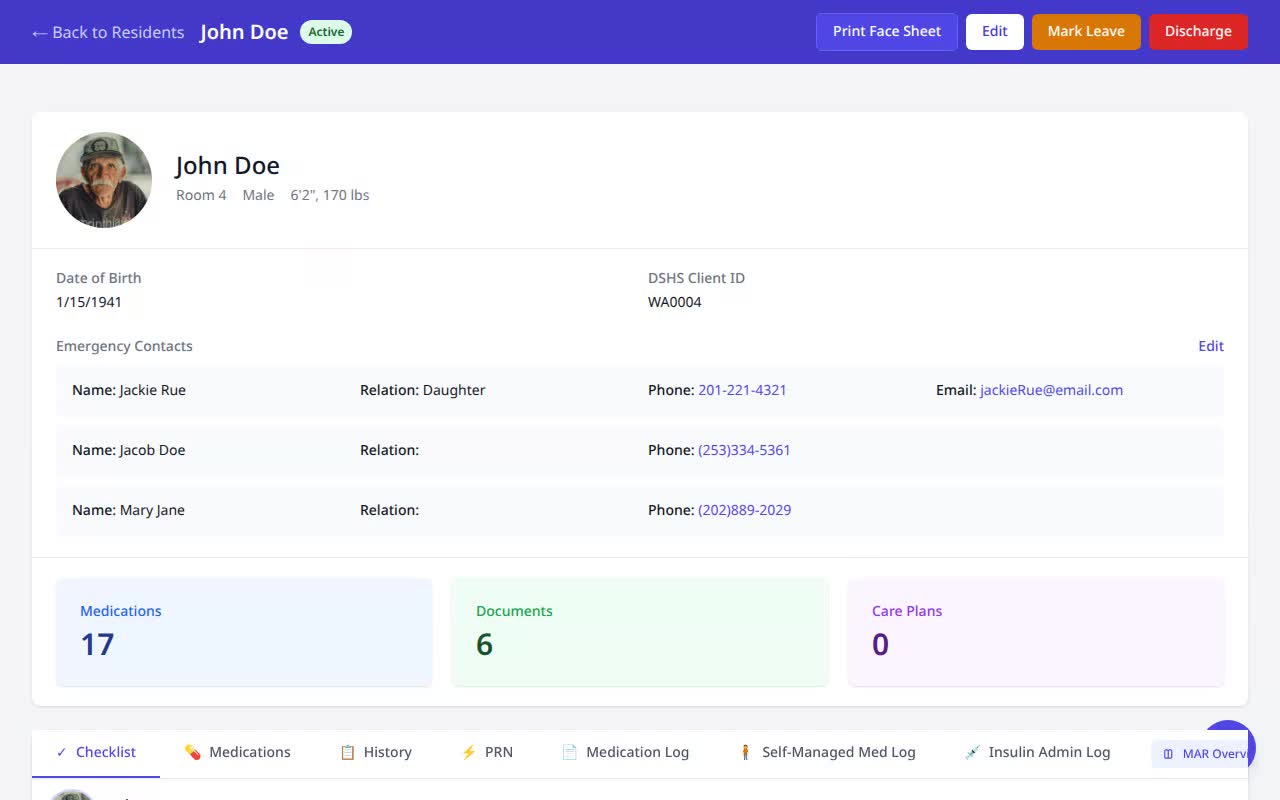
- Evacuation capability. Each resident must be identified as Independent or Assistance required in the assessment, preliminary service plan, and NCP (WAC 388-76-10870).
- Legal documents. Keep copies of powers of attorney and guardianship orders when they're available (WAC 388-76-10325).
2. Medications
- The medication log. Keep a daily log for every resident except those assessed as independent with self-administration.
- The log shows the initials of the staff member who assisted with or gave each medication.
- Refused doses are logged with the reason (WAC 388-76-10475).
- Order changes. Each change starts with a logged call requesting written verification, followed by that written verification (WAC 388-76-10475).
- Timing and special directions. Medications are given at the times the practitioner ordered and according to directions such as "before meals" or "at bedtime" (WAC 388-76-10470).
- Storage. Medications are locked, kept in their original labeled containers, and stored appropriately for each drug (WAC 388-76-10485).
- Disposal. You need a written disposal policy that covers disposal within 30 days. Each disposal record shows the resident, medication, amount, date, and the person completing it (WAC 388-76-10490).
- Altered medications. Crushing or splitting a medication requires a documented consultation with a practitioner or pharmacist first (WAC 388-76-10465).
- Level of assistance in the NCP. The NCP states how much medication assistance each resident needs and why (WAC 388-76-10460).
See Common Medication Documentation Problems in Washington AFHs for how each of these goes wrong.
3. Staff files
- Background checks.
- No one with disqualifying information may be employed in a role with unsupervised access to residents (WAC 388-76-10180).
- A conditional hire is allowed only if the background check is submitted within one working day, the person has no unsupervised access to residents, and they work under direct supervision (WAC 388-76-10175).
- Tuberculosis testing within three days of employment. This covers providers, caregivers, staff, and volunteers who provide care (WAC 388-76-10265).
- CPR and first aid. Required cards are valid and on file (WAC 388-76-10130; WAC 388-112A-0720).
- Training under chapter 388-112A WAC. Orientation, safety training, the 70-hour basic training, and any required specialty training (dementia, mental health, developmental disabilities).
- Continuing education. 12 hours by the caregiver's birthday each year (WAC 388-112A-0610).
- Nurse delegation credentials for anyone performing delegated tasks. See section 4.
4. Nurse delegation
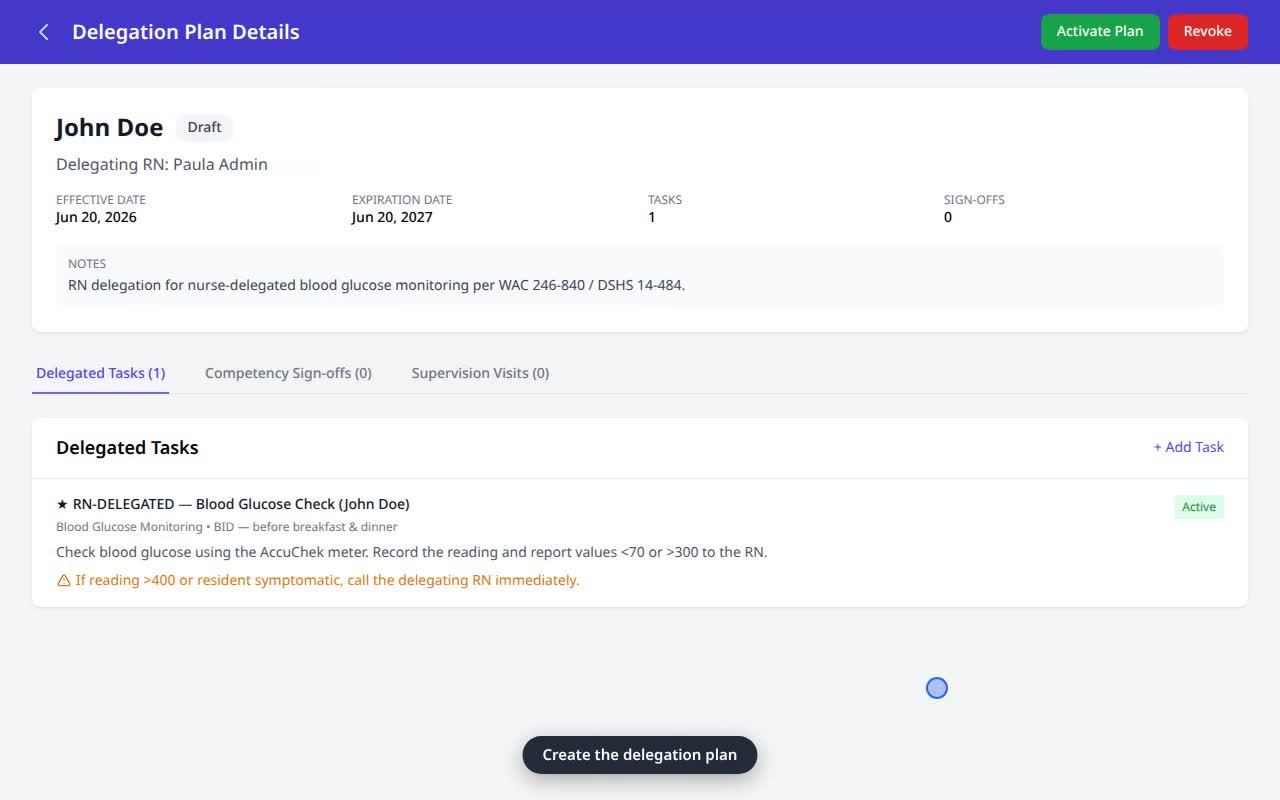
If caregivers perform delegated nursing tasks such as insulin injections, the file for each resident and task should hold:
- Written consent from the resident or their authorized representative (WAC 246-840-930(10)).
- Written, resident-specific instructions from the delegating RN, with a copy in the resident's record (WAC 246-840-930(12)).
- Evidence for each caregiver of their credential and of DSHS nurse delegation core training, plus the diabetes training for insulin (WAC 388-112A-0550).
- Supervision records.
- At least every 90 days.
- For insulin, every two weeks for the first four weeks (WAC 246-840-930).
The full rules are in RN Delegation in Washington Adult Family Homes.
5. Emergency preparedness and fire safety
- Emergency and disaster plan. A written plan that meets each resident's needs (WAC 388-76-10830).
- Staff are trained on it before they begin work.
- Staff and residents review it at least once a year (WAC 388-76-10855).
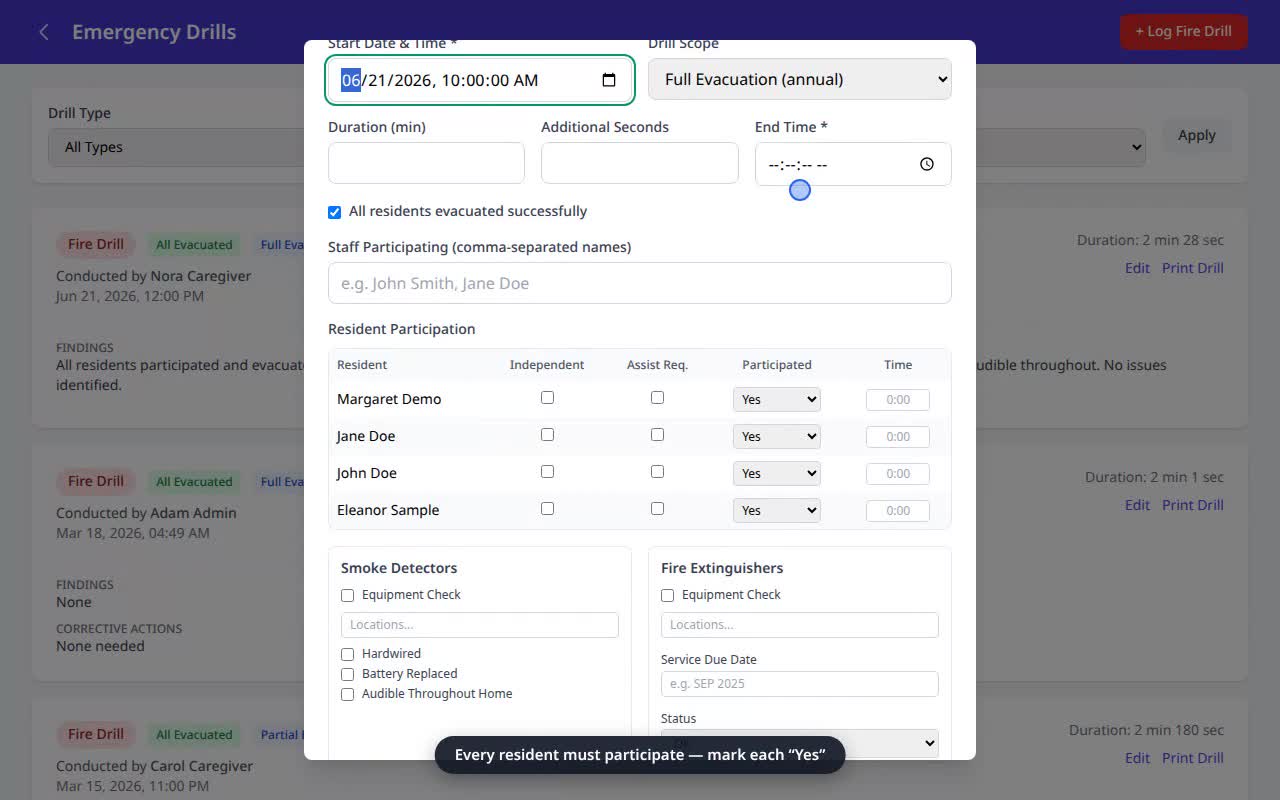
- Evacuation drills.
- Partial drills at least every two months during random staffing shifts.
- A full drill at least once each calendar year (WAC 388-76-10895).
- Every drill is documented (WAC 388-76-10900).
- Five-minute evacuation. You must be able to get all residents to a safe location outside in five minutes or less (WAC 388-76-10865).
- Emergency supplies. At least 72 hours of food and drinking water for residents and household members (WAC 388-76-10840, -10845).
- Smoke alarms. Interconnected alarms in every bedroom, near sleeping areas, and on every level, kept in working order (WAC 388-76-10805).
- Hot water. 105°F to 120°F at fixtures used by or accessible to residents (WAC 388-76-10750).
The drill rules are covered in detail in How to Run and Document Evacuation Drills.
A 10-minute self-audit you can run this week
- Pick two residents at random. Can you put their current NCP, assessment, and medication log in front of someone within two minutes?
- Check that each NCP is dated within the last 12 months and signed by both the resident and the home.
- Look at the last two months of the drill log. Is there a partial drill in each two-month window? Is there a full drill this calendar year?
- Check a staff file each for your newest and longest-serving caregiver: background check, TB, CPR/first aid, and CE hours toward their next birthday.
How VentoFlo helps
VentoFlo keeps these records in one place for Washington homes. When a licensor arrives, it produces a one-click inspection bundle: a ZIP of organized PDFs covering MARs and medication logs, negotiated care plans, fire drills, controlled-substance counts, disposals, RN delegation records, training records, and personnel files.
Start a 14-day free trial → · Book a demo →
Frequently asked questions
How often does DSHS inspect Washington adult family homes?
Under RCW 70.128.070, licensed adult family homes are inspected at least every 18 months, with a statewide annual average of 15 months. A home with no citations on its last three inspections and no complaint violations in the same period may go up to two years. DSHS may also inspect unannounced at any time, including during complaint investigations.
Can a DSHS licensor show up without notice?
Yes. RCW 70.128.070 allows the department to make an unannounced inspection of a licensed home at any time, and WAC 388-76-10003 requires the home to let department staff examine all areas and articles in the home.
How long must a Washington AFH keep resident and staff records?
Resident records must be kept for three years after the resident leaves the home or dies (WAC 388-76-10315). Personnel records must be kept during employment and for at least two years after employment ends (WAC 388-76-10198).
Are electronic records acceptable during a DSHS inspection?
Chapter 388-76 WAC focuses on what the records contain and on their availability to department staff, not on paper. Electronic records work well as long as they are complete, show who recorded each entry and when, and can be produced promptly when a licensor asks for them.
When must the negotiated care plan be completed and reviewed?
The negotiated care plan must be completed within 30 days of admission (WAC 388-76-10360). It must be reviewed after a significant change in condition, when it no longer meets the resident's needs, when requested, and at least every 12 months (WAC 388-76-10380).
This guide summarizes Washington rules as of the review date above for general information. It is not legal advice. Always confirm requirements against the current text at app.leg.wa.gov and with your licensor.
Built for Washington adult family homes
VentoFlo maps your daily records to chapter 388-76 WAC: an eMAR that prevents double-dosing, negotiated care plans on the current DSHS form, evacuation drills, RN delegation, and a one-click DSHS inspection bundle with up to 34 sections.
More Washington AFH guides
- 7 Common Medication Documentation Problems in Washington Adult Family Homes (and How to Prevent Them)
- How to Write a Compliant Washington Negotiated Care Plan (WAC 388-76-10355)
- How to Run and Document Evacuation Drills in a Washington Adult Family Home
- RN Delegation in Washington Adult Family Homes: Who Qualifies, Consent, Supervision and Records
- CBHS and Form HCA 13-0126: A Guide for Washington Medicaid Adult Family Homes