
CBHS and Form HCA 13-0126: A Guide for Washington Medicaid Adult Family Homes
How Community Behavioral Health Support (CBHS) works for Washington AFHs: eligibility under WAC 182-561, service tiers, daily supportive-supervision logging, and the HCA 13-0126 form submitted on request.
6 min read · Last reviewed November 17, 2026
Residents with significant behavioral health needs often need more staff time than standard personal care pays for. Since July 2024, Washington's Community Behavioral Health Support (CBHS) benefit has paid for that time.
CBHS is administered by the Health Care Authority (HCA) under chapter 182-561 WAC. It pays licensed residential providers, including adult family homes, for supportive supervision: monitoring, cueing, redirection and de-escalation that prevent at-risk behavior.
Getting CBHS approved is only half the work. The other half is daily documentation that proves the service was delivered.
1. How chapter 182-561 WAC is organized
| Section | Covers |
|---|---|
| 182-561-0300 | Eligibility |
| 182-561-0400 | Covered services |
| 182-561-0500 | Service tiers |
| 182-561-0600 | Providers |
| 182-561-0700 | Eligible diagnoses |
| 182-561-0800 | Appeals |
2. Who is eligible (WAC 182-561-0300)
A resident must meet all of these general criteria:
- Apple Health coverage. Covered under categorically needy or the Alternative Benefits Plan.
- Long-term care services. Already receiving a qualifying program such as COPES, Community First Choice or Medicaid Personal Care.
- Income. Countable income at or below 150% of the federal poverty level.
- Age. 18 or older.
- Diagnosis. An eligible diagnosis from WAC 182-561-0700, a broad mental and behavioral health list.
The resident must also meet needs-based and risk-based criteria:
- Needs. Help with ADLs, for example hands-on assistance with at least one ADL.
- Risk. At least one qualifying behavior in the last 12 months, or behavior that is prevented now only because of added staffing.
- History. Either unsuccessful community living, or a psychiatric history with functional decline.
The state, not the provider, decides. HCA makes the official determination of eligibility and tier, and reassesses every 12 months. A provider's job is to spot likely candidates and supply accurate information.
3. Service tiers (WAC 182-561-0500)
Authorization comes in tiers based on how often and how intensely the behaviors occur. Each tier sets a range of supportive-supervision hours per day:
| Tier | Hours/day |
|---|---|
| 1 | 0.5 – 2.0 |
| 2 | 2.1 – 6.0 |
| 3 | 6.1 – 10.0 |
| 4 | 10.1 – 15.0 |
| 5 | 15.1 – 20.0 |
| 6 | 20.1 – 24.0 |
The hours you actually deliver should line up with the authorized tier. If they consistently don't, in either direction, the tier may need to be revisited.
4. What caregivers should document every day
Supportive supervision must be logged every day it is provided. Each entry is tied to the behaviors and standard interventions in the resident's plan. One checkbox at the end of the month doesn't do it. Each entry should capture:
- The behavior and its trigger. Describe what happened specifically, for example verbal agitation, exit-seeking or paranoia, and what came before it.
- The intervention. Record exactly what staff did, such as verbal redirection, cueing a structured routine, a calming technique, or 1:1 monitoring.
- Time spent. Supervision is authorized in hours, so record the minutes.
- The outcome. Note how the resident responded and whether the behavior de-escalated.
Avoid: "Resident had a good day." Notes that repeat the same words day after day, or that have blank days, undermine the hours you report.
5. Form HCA 13-0126
HCA 13-0126, the CBHS Supportive Supervision Services Tracking Form (current revision 2/25), is HCA's tracking form for supportive supervision. It captures:
- Resident and provider details. The resident's identifying information, including their ProviderOne ID, the facility, the authorized tier, and the month.
- Behaviors. Up to eight behaviors and their standard interventions, taken from the resident's support or care plan.
- Weekly grids. A grid of daily supervision for each week, with a weekly narrative summary of behaviors, unusual events, interventions and successes.
You don't routinely submit the form. The daily log is the ongoing requirement; the 13-0126 is produced and submitted when HCA or a reviewer requests it. Because a request can come at any time, and can cover any past month, keep every month's daily log complete and be ready to turn it into a 13-0126 on short notice. Daily records that agree with what you bill are what protect you in an audit.
6. CBHS vs. IBSS
Intensive Behavioral Supportive Supervision (IBSS) is a separate benefit that mirrors CBHS. Its key differences:
- Who approves it. Managed care organizations (MCOs), as an "in lieu of" service, not HCA's CBHS program.
- Tiers. Only tiers 3–6.
- Hospital history. It generally requires a hospital admission in the prior 12 months.
Documentation for IBSS follows the MCO's requirements, so confirm with the plan which form it expects.
7. How behavior documentation helps at CARE reassessment
For DSHS-paid residents, the case manager's CARE assessment (chapter 388-106 WAC) counts documented behaviors and how often they occur, alongside ADL needs and cognition. Consistent daily behavior notes give the case manager accurate information at annual and significant-change reassessments. That makes it more likely the resident's classification reflects the care your home actually provides.
How VentoFlo helps
VentoFlo has tools built specifically for Washington Medicaid AFHs:
- CBHS Opportunity scan. Estimates which residents are likely CBHS-eligible under WAC 182-561-0300, with a tier range. HCA still makes the official decision.
- CARE classification estimate. Estimates each resident's classification under WAC 388-106 from their assessment.
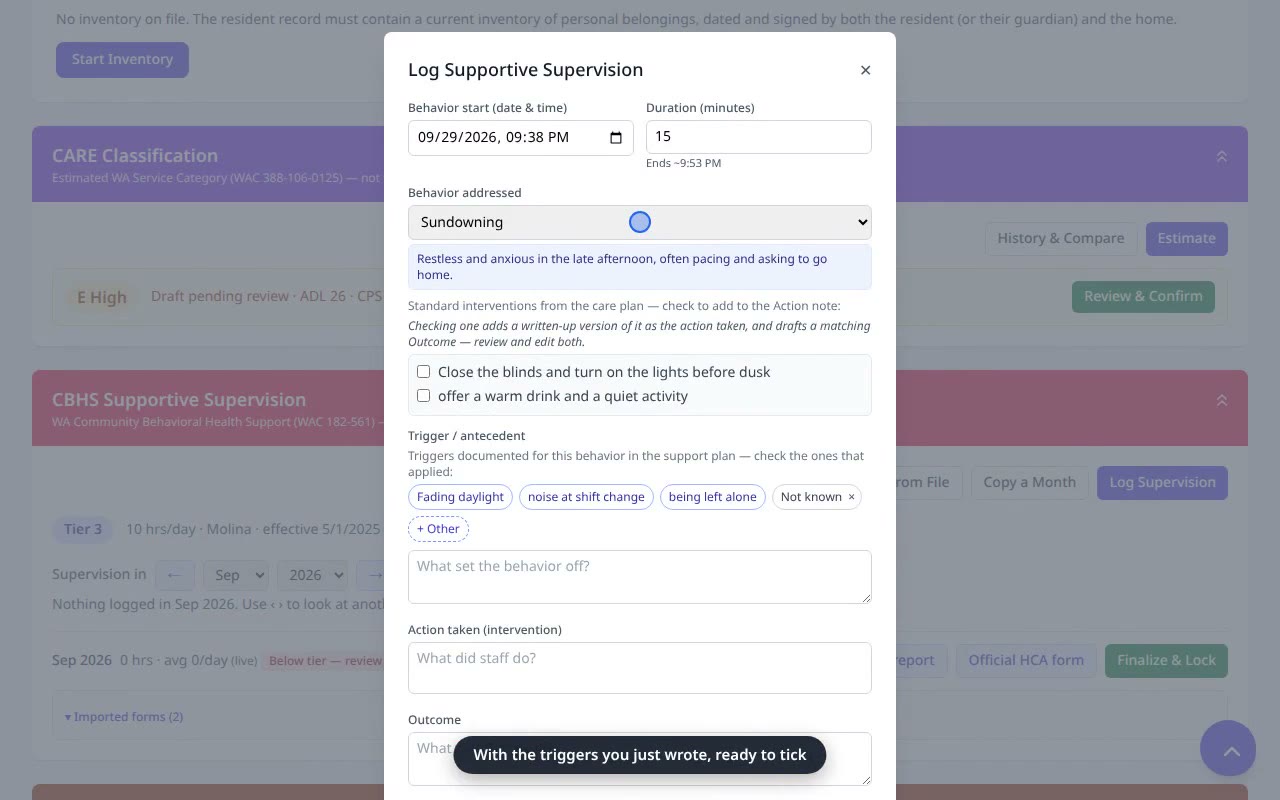
- Supportive-supervision log. Daily entries tie each behavior to its interventions, and the minutes roll up against the resident's authorized tier.
- HCA 13-0126 on request. When a 13-0126 is requested, generate it on the official form from any month's daily entries. Past forms you've already filed, whether monthly or weekly, can be imported.
Watch: generate the 13-0126 → · Book a demo →
Frequently asked questions
What is CBHS in a Washington adult family home?
Community Behavioral Health Support (CBHS) is a Washington Apple Health benefit, administered by the Health Care Authority under chapter 182-561 WAC. It pays licensed residential providers such as adult family homes for supportive supervision, meaning monitoring, cueing, redirection and de-escalation for eligible residents with significant behavioral health needs.
Who decides whether a resident qualifies for CBHS?
The Health Care Authority makes the official eligibility and tier determination under WAC 182-561-0300 and -0500, and reassesses every 12 months. Providers can identify likely candidates, but they can't approve CBHS themselves.
What is Form HCA 13-0126?
HCA 13-0126 is the CBHS Supportive Supervision Services Tracking Form. It records the resident's information, authorized tier and month, up to eight behaviors with their standard interventions, and weekly grids of daily supervision with weekly narrative summaries. Supportive supervision is logged daily, and the form is submitted when HCA or a reviewer requests it rather than on a routine schedule.
Does supportive supervision have to be logged every day?
Yes. Supportive supervision must be logged each day it is provided. Each entry should describe the specific behavior and its trigger, the intervention staff provided, the time spent, and how the resident responded. Avoid vague, repetitive notes, because daily records must support the hours reported against the resident's authorized tier.
What is the difference between CBHS and IBSS?
CBHS is HCA's benefit under chapter 182-561 WAC. Intensive Behavioral Supportive Supervision (IBSS) is a managed-care "in lieu of" service approved by the resident's MCO. IBSS covers only tiers 3–6 and generally requires a hospital admission in the prior 12 months.
This guide summarizes Washington program rules as of the review date above for general information. It is not legal or billing advice. Confirm requirements against chapter 182-561 WAC and current HCA guidance.
Built for Washington adult family homes
VentoFlo maps your daily records to chapter 388-76 WAC: an eMAR that prevents double-dosing, negotiated care plans on the current DSHS form, evacuation drills, RN delegation, and a one-click DSHS inspection bundle with up to 34 sections.
More Washington AFH guides
- Washington AFH DSHS Inspection Checklist: What Licensors Review Under Chapter 388-76 WAC
- 7 Common Medication Documentation Problems in Washington Adult Family Homes (and How to Prevent Them)
- How to Write a Compliant Washington Negotiated Care Plan (WAC 388-76-10355)
- How to Run and Document Evacuation Drills in a Washington Adult Family Home
- RN Delegation in Washington Adult Family Homes: Who Qualifies, Consent, Supervision and Records