
RN Delegation in Washington Adult Family Homes: Who Qualifies, Consent, Supervision and Records
Washington nurse delegation for AFHs: which caregivers qualify, what can never be delegated, written consent and instructions, 90-day supervision, and the insulin rules.
6 min read · Last reviewed November 17, 2026
Nurse delegation lets a registered nurse authorize a trained, credentialed caregiver to perform a specific nursing task for a specific resident. Insulin injections are the most common example. It's how many Washington adult family homes care for higher-acuity residents without a nurse on site.
Three sets of rules govern it:
- RCW 18.79.260 and WAC 246-840-910 through 970 (the Nursing Commission)
- WAC 388-112A-0550 (DSHS training)
- WAC 388-76-10405 and -10455 (AFH licensing)
If the home can't provide needed nursing care itself, it must contract with a licensed nurse or hire or contract a nurse to provide delegation (WAC 388-76-10405).
First: is it delegation, or medication assistance?
Not every medication task needs delegation. Self-administration with assistance (WAC 388-76-10450) covers a resident who can take or apply the medication themselves and knows they're taking it. A caregiver may set up the dose, remind or coach, use an enabler, and steady or guide the resident's hand with eye, ear or nasal drops and ointments. "Hand-over-hand" administration is not allowed.
When the caregiver actually gives the medication to a resident who can't self-administer, that's administration, and in an AFH it needs RN delegation (WAC 388-76-10455).
1. Which caregivers can be delegated to
Under WAC 388-112A-0550, before performing any delegated task in an adult family home, the caregiver must:
- Hold a credential. They must be a certified home care aide (chapter 18.88B RCW) or a nursing assistant-certified (chapter 18.88A RCW).
- Complete the training. They must finish DSHS's designated nurse delegation core training, "Nurse Delegation for Nursing Assistants & Home Care Aides."
The Nursing Commission rules add more requirements (WAC 246-840-930(8)):
- The credential is current and without restriction.
- The caregiver has completed basic caregiver training as well as core delegation training.
- The RN verifies all of this before delegating.
What about NA-Rs? A nursing assistant-registered can receive delegation in two situations defined in WAC 388-112A-0550:
- The worker is exempt from home care aide certification.
- Delegation is needed before HCA certification can be obtained.
In both cases the worker must also complete the core competencies of basic training. So it isn't true that NA-Rs can never be delegated, but in an AFH the default credential is a certified HCA or an NA-C.
Insulin needs one more course. A caregiver who will give insulin injections must also complete DSHS's specialized diabetes nurse delegation training (WAC 388-112A-0550(4)).
2. What can and cannot be delegated
The RN decides task by task, using the decision process in WAC 246-840-940. The resident's condition must be stable and predictable (RCW 18.79.260(3)(e)).
Commonly delegated in AFHs:
- Insulin injections. Insulin is the only injection that can be delegated.
- Blood glucose testing (WAC 246-840-935).
- Giving non-injected medications to residents who can't self-administer, such as eye drops, inhalers and topicals.
- Tube feedings and simple dressing changes, when the RN judges them appropriate.
Never delegable:
- Any injection other than insulin. This covers intramuscular, intradermal, subcutaneous, intravenous and every other route.
- Sterile procedures.
- Central line maintenance.
- Any act that requires nursing judgment (RCW 18.79.260(3); WAC 246-840-930(13)).
3. Consent
The resident or their authorized representative must give written consent to the delegation process (WAC 246-840-930(10)):
- Verbal consent is acceptable only if written consent follows within 30 days.
- Electronic consent is acceptable.
- Consent is needed once per resident, when delegation is first used. It isn't needed again each time a task is added or changed.
4. Written instructions
The RN gives specific, written delegation instructions to each caregiver, and a copy goes in the resident's record (WAC 246-840-930(12)). The instructions cover:
- the rationale for delegating
- the task's limits and the procedure
- the risks, side effects and what to report
- how to handle order changes
- how to document the task
- how often the RN will supervise
5. Delegation is tied to one resident and one caregiver
A delegated task is specific to one resident and not transferable to another resident. It is also specific to one caregiver and not transferable to another caregiver (WAC 246-840-930(12)(b)–(c)).
- If Caregiver A is delegated insulin for Resident 1, they can't give insulin to Resident 2 until the RN delegates that task separately.
- A newly hired caregiver can't perform any delegated task until the RN trains them, verifies them and delegates to them.
- If the delegating RN changes, a new RN may take over only by agreeing in writing to supervise (WAC 246-840-950).
6. Supervision and reevaluation
- At least every 90 days, the RN supervises and reevaluates the delegation and documents it (WAC 246-840-930).
- Insulin is stricter. Supervision is at least every two weeks for the first four weeks, then at least every 90 days.
- The method can be direct observation or another way of verifying the caregiver's competency.
- Rescinding. The RN may withdraw the delegation if the resident's condition is no longer stable and predictable, if the caregiver's competency or willingness changes, or if the task isn't being done correctly. When that happens, the RN must document why and help put an alternative plan in place (WAC 246-840-960).
Records to keep on file
For each resident and delegated task:
- the written consent
- the RN's written instructions
- each caregiver's credential, core training and (for insulin) diabetes training
- the RN's competency verification for each caregiver
- the supervision and reevaluation notes
How VentoFlo helps
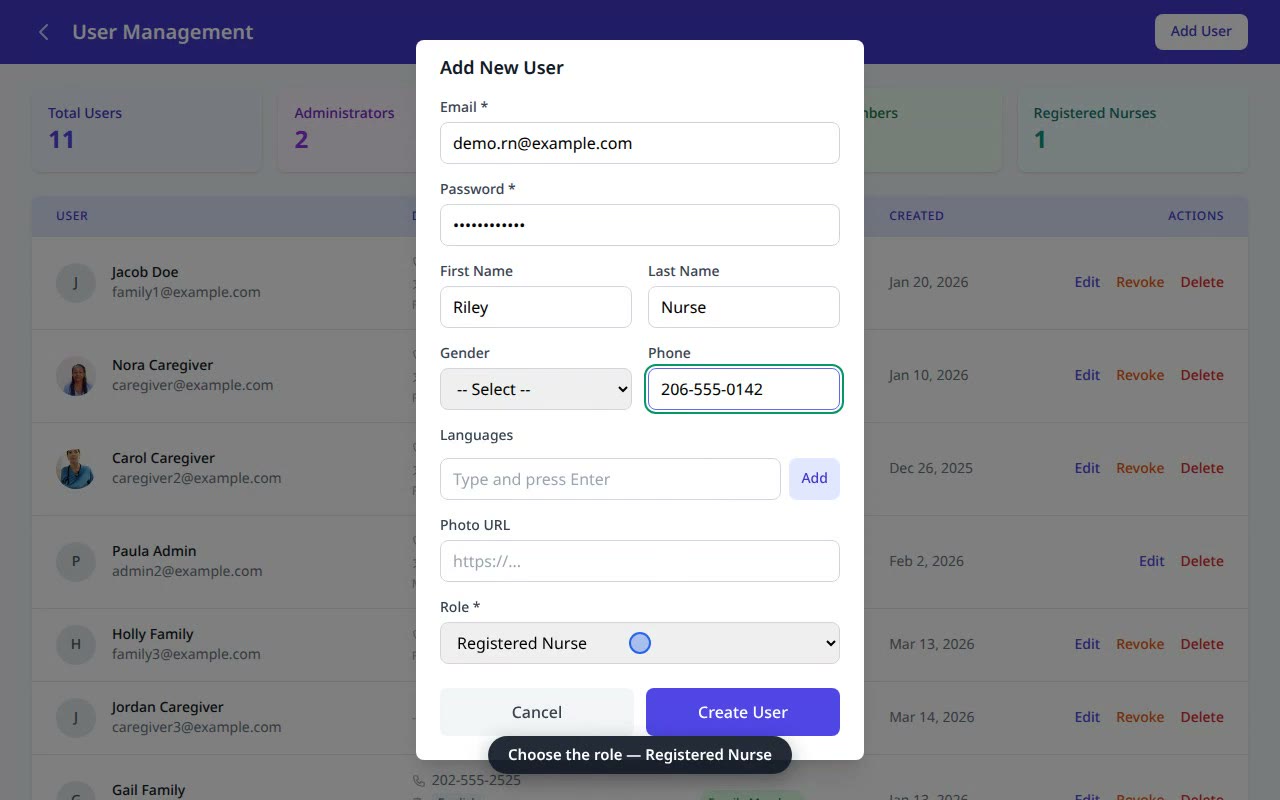
- Separate RN login. Delegating nurses get their own RN Delegation Portal.
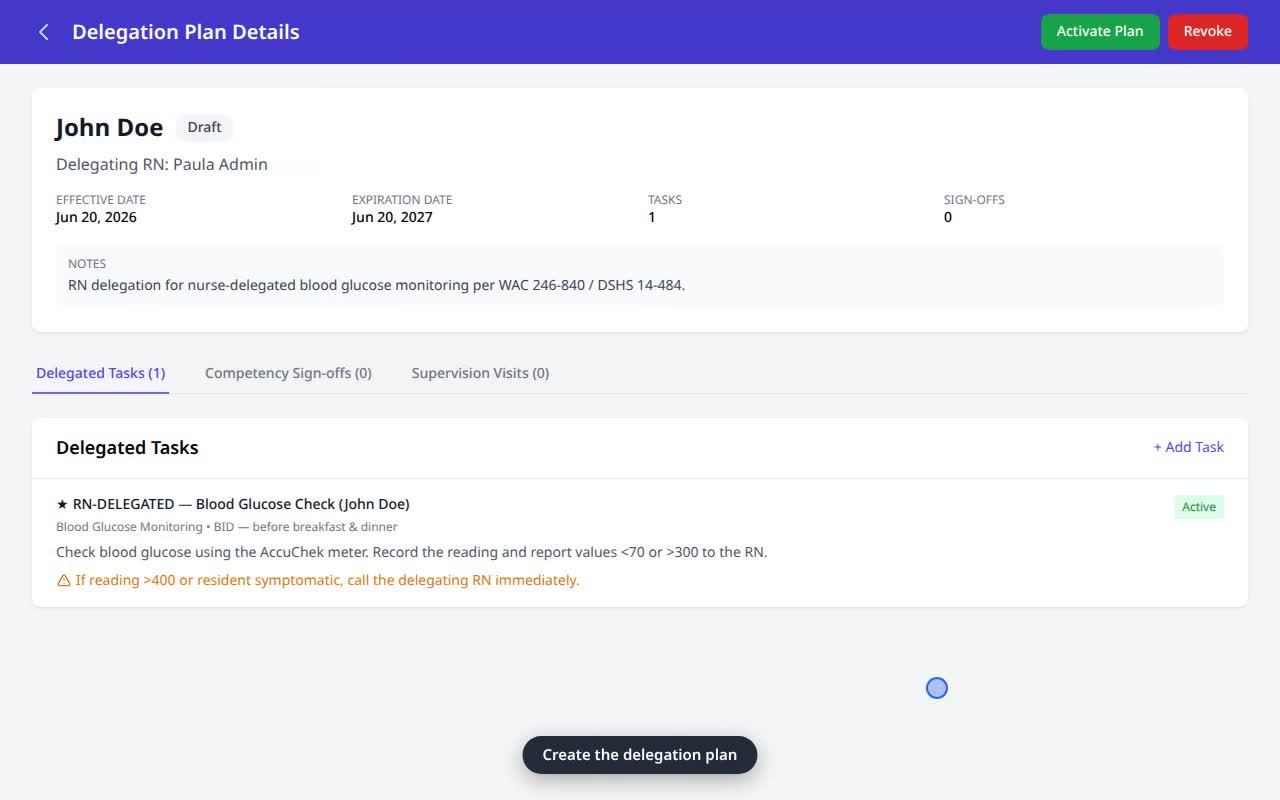
- Delegation plans. Plans are built per resident, with consent details and the signed plan filed as a versioned document.
- Caregiver records. VentoFlo records competency sign-offs for each caregiver and logs supervision visits. A credential verification stores each caregiver's HCA or NA-C details and their core and diabetes training dates.
- Inspection bundle. Delegation and nursing-visit records go into the inspection bundle.
Watch the RN delegation how-to → · Start a 14-day free trial →
Frequently asked questions
How often must the delegating RN supervise in a Washington AFH?
At least every 90 days (WAC 246-840-930). For insulin injections, supervision is at least every two weeks for the first four weeks, then at least every 90 days. Supervision can be done by direct observation or another method of verifying competency.
Can a nursing assistant-registered (NA-R) receive nurse delegation?
Sometimes. In adult family homes, the default requirement is a certified home care aide or nursing assistant-certified credential plus DSHS nurse delegation core training. An NA-R may be delegated when the worker is exempt from home care aide certification, or when delegation is needed before certification can be obtained, provided they complete the core competencies of basic training (WAC 388-112A-0550).
What training does a caregiver need before giving insulin?
They need a certified home care aide or nursing assistant-certified credential, DSHS nurse delegation core training, and the DSHS specialized diabetes nurse delegation training. They also need a resident-specific delegation from an RN (WAC 388-112A-0550; WAC 246-840-930).
Does a delegation carry over to a new resident or a new caregiver?
No. A delegated task is specific to one resident and one caregiver and can't be transferred to another of either (WAC 246-840-930). Each new resident needs consent and an RN delegation, and each new caregiver must be trained, verified and delegated by the RN.
What tasks can never be delegated?
Injections other than insulin, sterile procedures, central line maintenance, and any act requiring nursing judgment (RCW 18.79.260; WAC 246-840-930).
This guide summarizes Washington rules as of the review date above for general information. It is not legal or nursing advice. Confirm requirements against the current text of chapter 246-840 WAC and WAC 388-112A-0550, and with your delegating RN.
Built for Washington adult family homes
VentoFlo maps your daily records to chapter 388-76 WAC: an eMAR that prevents double-dosing, negotiated care plans on the current DSHS form, evacuation drills, RN delegation, and a one-click DSHS inspection bundle with up to 34 sections.
See it in VentoFlo
More Washington AFH guides
- Washington AFH DSHS Inspection Checklist: What Licensors Review Under Chapter 388-76 WAC
- 7 Common Medication Documentation Problems in Washington Adult Family Homes (and How to Prevent Them)
- How to Write a Compliant Washington Negotiated Care Plan (WAC 388-76-10355)
- How to Run and Document Evacuation Drills in a Washington Adult Family Home
- CBHS and Form HCA 13-0126: A Guide for Washington Medicaid Adult Family Homes