
How to Run and Document Evacuation Drills in a Washington Adult Family Home
Partial drills every two months, one full drill a year, a five-minute evacuation standard, and five things every drill record must show. A Washington AFH guide.
5 min read · Last reviewed November 17, 2026
A licensor checks emergency preparedness on almost every visit, and drill records are among the quickest things to check. Washington's rules are specific: how often you drill, what kind of drill, how fast residents must get out, and what you write down. Most citations come from a missing drill or a log that leaves out a required detail.
1. Two kinds of drills, two schedules (WAC 388-76-10895)
| Drill | What it is | How often |
|---|---|---|
| Partial | Residents evacuate to the designated emergency exit | At least every two months, during random staffing shifts. Each resident must take part in at least one each calendar year |
| Full | Residents evacuate from the home to the designated safe location | At least once each calendar year, with all residents participating together at the same time |
A few points people miss:
- Drill even when the home is empty. Drills are required even when no residents live in the home, so staff keep practicing (WAC 388-76-10895(2)(c)).
- Vary the shifts. "Random staffing shifts" means drills shouldn't always fall on the day shift when extra hands are around. Spreading them across shifts, including when residents are asleep, shows how your home actually performs.
2. The five-minute standard (WAC 388-76-10865)
The home must be able to evacuate all residents to a safe location outside the home in five minutes or less. The same rule says:
- Residents leave through a door designated as an emergency exit.
- Each resident's path from their bedroom must not go through another bedroom.
- No elevators, chairlifts or platform lifts may be used.
- Residents who need help to evacuate need a route to the safe location that doesn't require stairs.
- Homes serving residents who can't hear the fire alarm must install visual fire alarms.
If a drill runs long, find out why. Common causes are a resident's mobility changing, staffing, or a blocked path. Then fix it, update the resident's NCP and your emergency plan, and drill again to prove the home can meet the standard. WAC 388-76-10860 also bars admitting or keeping residents who can't safely be evacuated.
3. What every drill record must show (WAC 388-76-10900)
The rule requires five items:
- Names of each resident and staff member involved.
- Name of the person conducting the drill.
- Date and time of the drill.
- Whether it was a full or partial evacuation.
- How long the evacuation took.
These details aren't required, but they make the record much stronger:
- each resident's individual time and the help they needed
- the exit used
- whether the alarms sounded
- problems found and the corrective action taken
Time it for real. Writing "5 minutes" for every drill looks estimated. Record minutes and seconds from a stopwatch.
4. When a resident refuses to take part (WAC 388-76-10895(3))
Residents may refuse to take part in a drill. The home must respect that, but it still has to show it can evacuate everyone safely. For a refusing resident you must:
- document the refusal in the negotiated care plan
- put an estimated evacuation time in the NCP, and explain how you calculated it
- add that estimate to the time recorded on the drill log after each drill, and confirm the total still doesn't exceed five minutes
- keep offering the resident the chance to take part in every drill
5. Connected requirements
- Evacuation capability. Each resident must be identified as Independent or Assistance required in the assessment, preliminary service plan and NCP (WAC 388-76-10870). A resident counts as Independent only if they can get out with no more than one cue.
- Training and annual review. Staff are trained on the emergency and disaster plan before they begin work, and staff and residents review it at least yearly (WAC 388-76-10855).
- Floor plan. Post an evacuation floor plan that shows exits and the designated safe location (WAC 388-76-10885).
- Reporting. The department must be notified after a fire or an actual evacuation (WAC 388-76-10905).
How VentoFlo helps
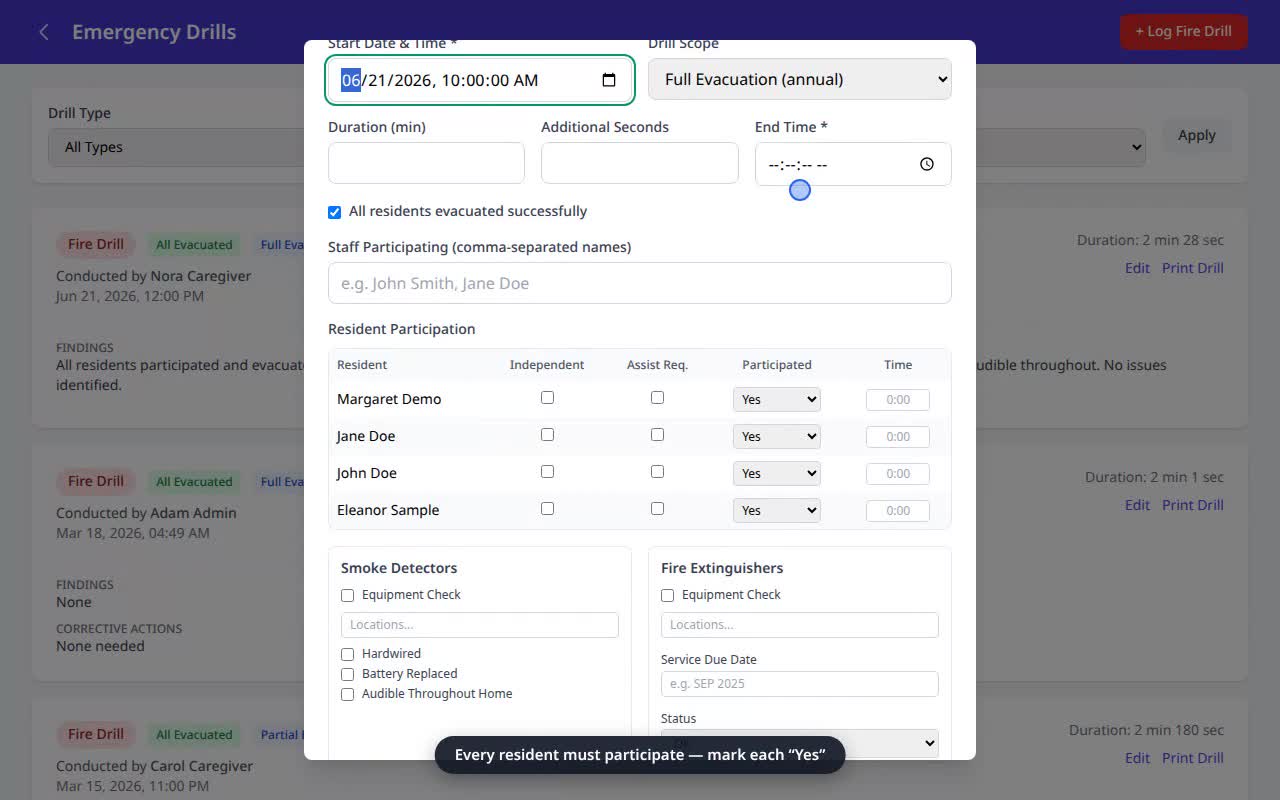
- Logging drills. VentoFlo's drill log records partial and full drills with each resident's evacuation time and level of assistance. The drill's total time is calculated from those times.
- Overdue flags. You're flagged when a partial drill is due on Washington's two-month cycle, or when the year's full drill hasn't happened yet.
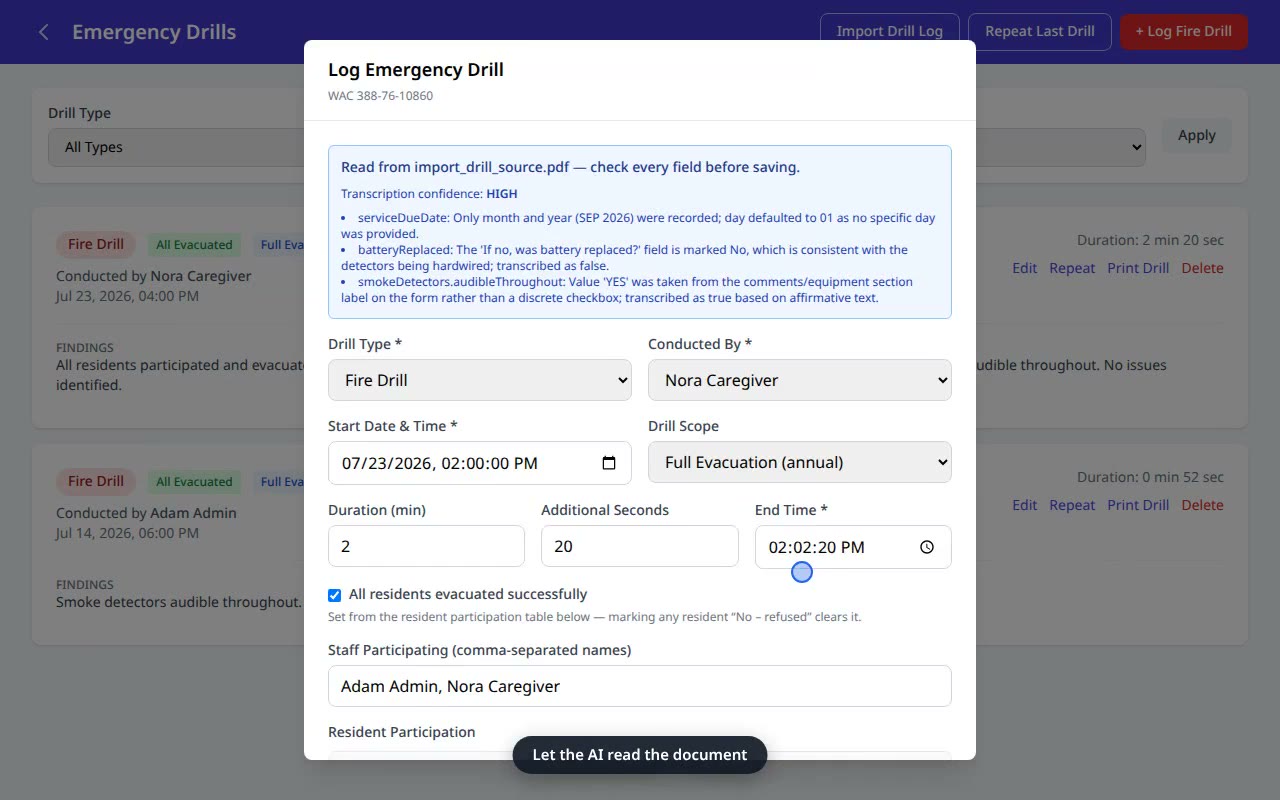
- Importing past drills. An AI import brings in drill logs you've already completed on paper.
- Inspection bundle. Every drill goes into the inspection bundle automatically.
Watch the fire drill how-to → · Start a 14-day free trial →
Frequently asked questions
How often must a Washington adult family home hold evacuation drills?
Partial evacuation drills are required at least every two months during random staffing shifts, with each resident taking part in at least one per calendar year. A full evacuation drill with all residents together is required at least once each calendar year (WAC 388-76-10895).
What is the maximum evacuation time for a Washington AFH?
The home must be able to evacuate all residents to a safe location outside the home in five minutes or less (WAC 388-76-10865).
What must a Washington AFH record for each evacuation drill?
The names of each resident and staff member involved, the name of the person conducting the drill, the date and time, whether it was a full or partial evacuation, and how long the evacuation took (WAC 388-76-10900).
What if a resident refuses to take part in a drill?
The home respects the refusal but documents it in the negotiated care plan, along with an estimated evacuation time and how that estimate was calculated. After each drill, the estimate is added to the recorded drill time to confirm the total stays within five minutes, and the resident keeps being offered the chance to participate (WAC 388-76-10895).
Do we need to hold drills if no residents live in the home?
Yes. Washington requires emergency evacuation drills even when no residents live in the home, so staff keep practicing (WAC 388-76-10895).
This guide summarizes Washington rules as of the review date above for general information. It is not legal advice. Confirm requirements against the current text at app.leg.wa.gov and with your licensor.
Built for Washington adult family homes
VentoFlo maps your daily records to chapter 388-76 WAC: an eMAR that prevents double-dosing, negotiated care plans on the current DSHS form, evacuation drills, RN delegation, and a one-click DSHS inspection bundle with up to 34 sections.
See it in VentoFlo
More Washington AFH guides
- Washington AFH DSHS Inspection Checklist: What Licensors Review Under Chapter 388-76 WAC
- 7 Common Medication Documentation Problems in Washington Adult Family Homes (and How to Prevent Them)
- How to Write a Compliant Washington Negotiated Care Plan (WAC 388-76-10355)
- RN Delegation in Washington Adult Family Homes: Who Qualifies, Consent, Supervision and Records
- CBHS and Form HCA 13-0126: A Guide for Washington Medicaid Adult Family Homes